Sticking / Soldering
Review local die temperature, spray coverage, alloy contact time, and film strength. Increasing spray quantity alone can create new problems.
Alloyform Technical Guide
A concise reference for common defects and the operating conditions that influence release-agent performance.
Troubleshooting
Start with the visible symptom, then review equipment and process conditions before changing the release agent.
Review local die temperature, spray coverage, alloy contact time, and film strength. Increasing spray quantity alone can create new problems.
Check overspray, cold die areas, incomplete evaporation, and residue from active materials. A lower-residue direction may be appropriate.
Confirm spray drying, venting, vacuum, plunger lubrication, and release-agent quantity. Product choice is only one part of the gas load.
Review residue, silicone requirements, cleaning effectiveness, and the complete coating or bonding sequence using actual production parts.
Process Controls
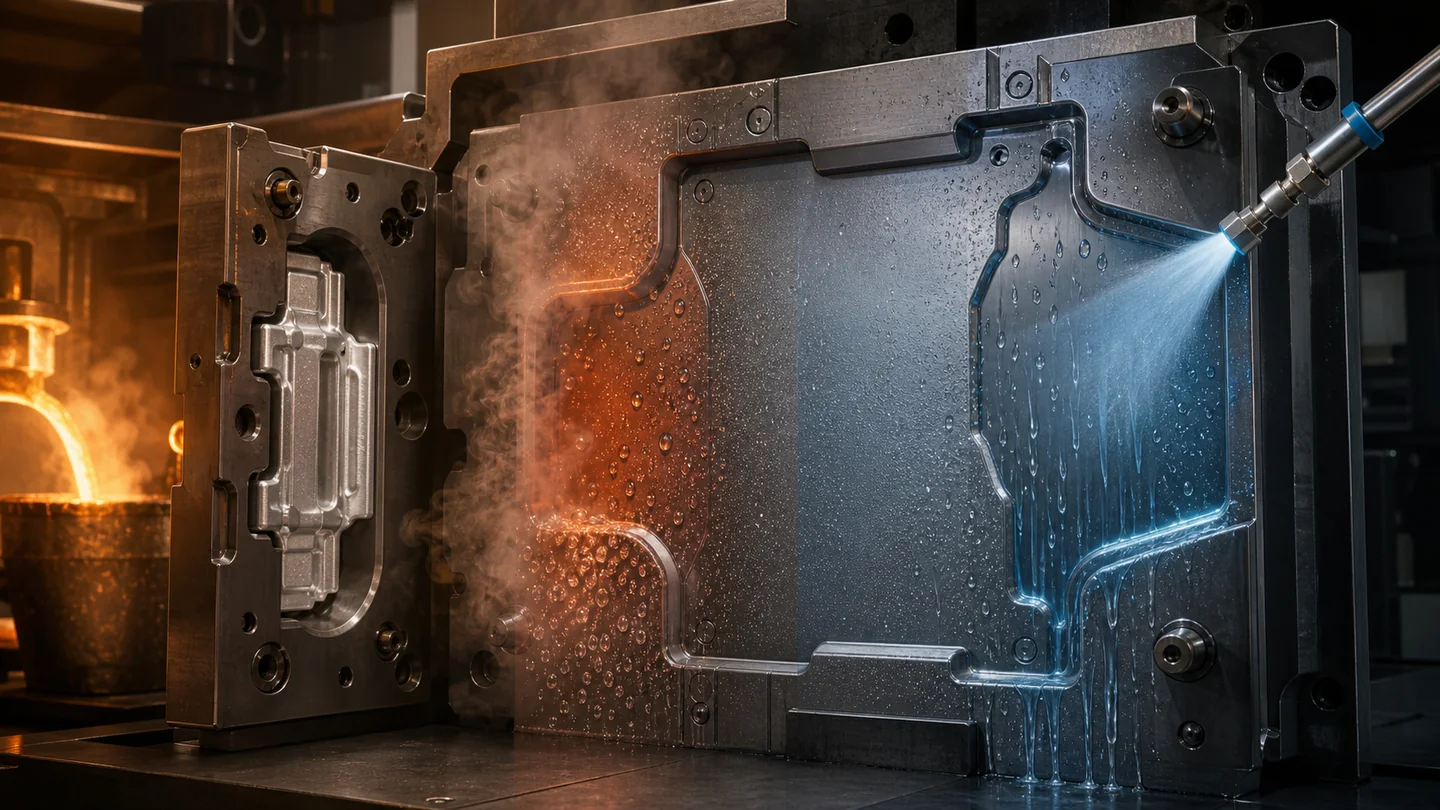
A die that is too cold can retain water and active material. A die that is too hot can prevent uniform deposition. Stable film formation depends on an effective temperature window.
There is no universal setting. Determine dilution against the release agent, machine, casting geometry, spray system, water quality, and target surface condition.
More spray is not automatically better. Excess can increase cooling, residue, gas load, wastewater, and cycle time. Use the minimum quantity that maintains reliable release.
Technical Articles Preview
Short technical notes for release-agent behavior, defect diagnosis, and cutting-fluid management.
Request Technical SupportEvaporation, active-material deposition, surface temperature, and spray control.
Separate product limitations from temperature, coverage, and process variation.
Concentration, pH, tramp oil, water quality, and routine fluid management.